 Discover how you initiate and maintain movement habits. Investigate new patterns. Our goal: more efficient, organized, powerful movement.
Prerequisite: at least 1 ATM series with Angela or personal invitation.
Cost: $90 for whole series; $25/ class. Limit: 5.
4 Saturdays, Dec. 3-31 (skip Dec. 24), 11:30 am-1:30 pm
Awareness Through Movement: 6-Week Series Begins
Leave a reply
Discover your innate strength and capacity to learn. Awareness Through Movement® (ATM®) offers a unique, profound way to examine and change your habitual and often limiting patterns of moving. You’ll learn to organize your physical self to move with greater ease and effectiveness, improving co-ordination, range of motion, and balance. LIMIT 15 participants.
“Truly remarkable such simple movements have such a large impact.”
—Michelle Accardo, MS, ATC, LMT, CLT
6 Tuesdays, Jan. 10-Feb. 14, 2017, 7:30-8:30pm. Register on the MoveStudio website.

More about Strength
Strength from the Ground
In my teaching, reclaiming your inherent strength has become the organizing principle.

© International Feldenkrais® Federation Archive, Robert Golden
One of my mentors, Jeff Haller, PhD, first pointed me in this direction. It’s the central theme of his advanced training program. He said, “if I train myself in any exercise system, and I’m sloppy in the way I provide support for myself, all I will do is train muscles based on supporting myself the way I am accustomed to.”
In other words, if I don’t improve my relationship to the ground, I’ll strengthen habits of self-use which don’t serve me and might actually harm me—which is how I sprained my ankle playing squash. (By the way, I then got up and finished the game: don’t do that!)
(Read more of Jeff’s thoughts about cultivating strength through Feldenkrais here.)
Are Humans Machines?
 Recently I’ve begun reading an excellent book which delves into the question from a slightly different angle: how do we define fitness? Author Edward Yu answers the question in depth. He looks at how the West has defined health, fitness, beauty, and the human body over a period of centuries, to see how we’ve arrived at the point where for many these are synonymous. As a martial artist, runner, and Feldenkrais practitioner, he asks, what are we fit for?
He writes: “If I am considered fit enough to be on a magazine cover, does that also make me fit for the rest of life, which occurs outside of the confines of 8 1/2 x 11 inches? Should Albert Einstein, who probably never performed a single push-up, be deemed unfit?”
How we came to equate our physical selves with machines (thank you, Descartes!) is key to Edward’s analysis of the contemporary conflation of fit/health/beauty.
Read the prologue to his book, The Mass Psychology of Fittism: Fitness, Evolution, and the First Two Laws of Thermodynamics, here.
How Do You Define Strength?
Often we think of strength from the physical perspective. When I searched for stock photos showing “strength,” what came up were dozens of images of bulging muscles and effort.
We can certainly appreciate the skill required to evoke strength at an extraordinary level. Witness the remarkable weight-lifting of Taner Sagir.
Of course we all want physical strength. We want to be strong enough to lift our children easily, lift groceries, practice yoga, or garden. Some of us want to be strong enough to practice an instrument for three hours and then play a concert. Or to run a marathon.

© International Feldenkrais® Federation Archive, R. Golden.
That was the kind of strength I was expecting to investigate during four days of advanced training last month at IOPS Academy (Ideal Organization & Profound Strength). But in his first talk our instructor, Dr. Jeff Haller, spoke of emotional strength.
Jeff described a client who’d experienced abuse as a child and has been living with its emotional weight for much of their life. That client is discovering a different way to inhabit their body, from the ground up, with clear contact of their feet, open chest, and unrestricted breath. The client can now feel the difference between this new pattern and the former. He’s gaining the tools to choose consciously between living in the past, with all its weight, and in the present with its relative ease, based on being aware of these patterns.
Group investigations that week allowed us to experience how we physically express fear. As they progressed, we were guided toward finding different responses—becoming pro-active, rather than reactive, assertive rather than cowering, calm rather than wary. In other words, Jeff invited us to discover emotional strength in ourselves, and observe its physical manifestations.
Above all, he invited us to be kind to ourselves.
I realized that I’ve held back from articulating publicly that there’s an emotional component to the Feldenkrais Method®. When a new client comes to talk about relieving physical pain, I’ve thought—oh, they’re not expecting to talk about the emotional side. So I’ve left it unstated. But when you discover limiting patterns of movement, you’ll inevitably discover related patterns of thinking and feeling.
In Body and Mature Behavior, Moshe Feldenkrais writes: “Every emotion. . . is associated and linked in the cortex with some muscular configuration and attitude.”
As you learn new choices, you learn new ways of thinking and feeling. Instead of being at the mercy of your past, you can choose what to keep and what to discard. You might literally feel more buoyant.
Strength is an evolving idea for me. A goal to move towards, sometimes approaching via the physical realm, sometimes the mental: two possible approaches to the same goal. I think human strength is synonymous with maturity. As we move through our lives, at each moment we have the choice between falling into old patterns or choosing the new. We can choose to relish our ability to thrive in uncertainty. As we uncover our inner strength, we can trust that we have the resources to respond without hesitation. We can aspire to anti-fragility.
Learning More about the Pioneer of Feldenkrais
To learn more about the pioneer of the Feldenkrais Method®, Moshe Feldenkrais, D.Sc., there’s no better source than the recently published first volume of his biography, Moshe Feldenkrais: A Life in Movement.
At 566 pages (including footnotes), the book is a remarkable achievement. Author Mark Reese worked closely with Dr. Feldenkrais, and was himself a teacher of the method, as well as a scholar.
Describing Moshe Feldenkrais, Norman Doidge, M.D., writer of two bestsellers on neuroplasticity writes in the book’s preface: “Genius of the magnitude possessed by Moshe Feldenkrais, defies categorization. . . [it’s] a fastidiously researched, exciting, profoundly insightful story, that gets deep inside the mind of the swashbuckling, theatrical, brilliant integrator, as he lived through many of the greatest intellectual, political, and scientific events of the the 20th century. . . who in his struggle to overcome his own major injury, pioneered a unique way of teaching people to learn how to learn, and to change their brains, by increasing awareness of whatever they did. . .”
May 6 is Moshe’s birthday. I never met him in person, but am forever grateful to have discovered his work. Here he is teaching a public workshop, speaking about good posture and Campbell’s soup. Happy birthday, Moshe!
|
Moshe Feldenkrais: South Bend, Indiana Feldenkrais Method Workshop 
|
Cultivating a Growth Mindset
You probably first researched the Feldenkrais Method® because you wanted to change. Maybe you wanted one of your knees to be more reliable in walking. Or to diminish back pain so you could run with pleasure.
You might have an explanation about why the problem exists. Like your age. Or because you have a particular skeletal pattern like scoliosis. Or because your gym teacher said you weren’t athletic.
 Feldenkrais practitioner John Tarr wrote an excellent blog, “Growth Mindset and Movement,” about the importance of believing you can change. Which means letting go of those explanations, your familiar stories, and creating space for something different with a growth mindset. He writes, “. . the march of time and fate do bring about irreversible changes, but often we are not fully using the potential we still have.” We can investigate this potential by cultivating curiosity, enjoying investigation and discovery the way we did as children.
John’s blog cites Carol Dweck, author of the book Mindset, and Maria Popova‘s summary on Brain Pickings. Read his complete blog here.
Making the Floor Your Friend
When was the last time you lay on the floor? Do you remember how delicious it felt to be completely supported and feel effort gradually drop away?
Stacy Barrows, Doctor of Physical Therapy and Feldenkrais Practitioner, wrote an excellent blog about the value of using the floor for more than getting from one place to another.

Stacy Barrows, PT, GCFP
Stacy says:
“When I practice getting up and down off the floor, I’m building resilience in my musculoskeletal system. Being able to get up and down off the floor is an essential movement skill. It is not only one of the first things we learn as infants; it is one of the last things we want to lose as we age. In fact, the ability to get up and down from the floor is associated with greater longevity. People who do this regularly are counteracting the long-term effects of gravity and maintaining their proprioceptive abilities that are part of maintaining upright balance and navigating the world with less risk of falling.”
Proprioception is how we sense where we are in space, and the speed and intensity with which we’re moving.
Read the rest of Stacy’s blog here, including tips for enticing your family to the floor.
And speaking of making friends with the floor, I can’t resist sharing this video of Baby Liv again. Babies don’t have to make friends with the floor. They love it!
Why Is Easy Movement Hard?
Feldenkrais® practitioner Michael Cann wrote an excellent blog in response to a student’s frustration after a workshop. Other participants had found the movements easy and enjoyable. The man wondered what was wrong with him.
Michael’s response is that the way we teach Feldenkrais can be misleading, because we emphasize making small, gentle movements. Only doing what’s easy. Resting frequently.
He writes: “With all this talk about ease, effortlessness, and pleasure, you’d think every experience would be enjoyable. . . But here’s the uncomfortable truth: it won’t be. There have been times when I have hated Feldenkrais. And there may be times when you will too. . . . easy movement can be way harder — and way more rewarding — than you have imagined.”
Read the rest of his blog here on his website Movement Is My Teacher.
Interoception: Awkward Word for Important Phenomenon
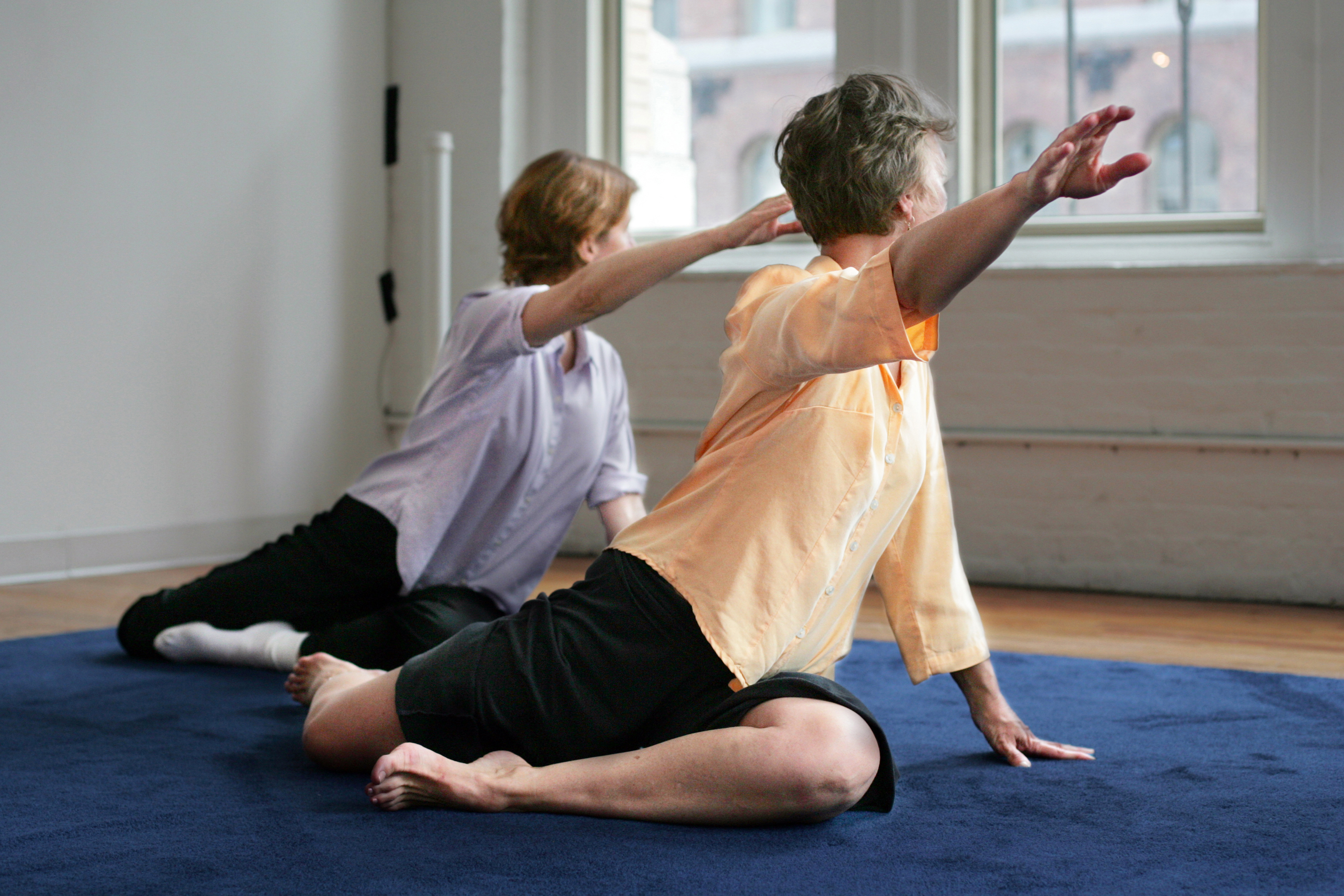
Awareness Through Movement lesson.
One of you recently shared interesting research into what happens physically when we attend to ourselves during meditation and mindfulness practices such as Awareness Through Movement®.
Being able to attend to, and learn from, how we move and other physiological states has critical survival value. Scientists have labelled this interoception, “the process of receiving, accessing and appraising internal bodily signals.”
Particularly important: there’s a link between well being and interoception. When we attend to ourselves in the specific ways invited by practices like Feldenkrais®, there’s potential for improving physical and psychological health.
Find the complete article here on the Frontiers in Psychology website.
Nothing’s Wrong: Why Explore Feldenkrais When You Feel Fine?
Most of us discover the Feldenkrais Method when something goes wrong. For me, it was neck spasms. For many, it’s back pain which resists massage, chiropractic, and other well-known treatments.
Why investigate the method if you feel fine?
Because most of us learn just enough about movement to get by. We function fine. Some of us learn far more—elite athletes, performing artists, surgeons, for example. But there’s so much more we can refine. So much to discover about how movement can be not just okay, but delightful—light, graceful, and effortless. Many more movement choices we can uncover and expand into.

MaryBeth Smith, GCFP
Feldenkrais teacher and vocal coach MaryBeth Smith underscored the value of an expanded movement vocabulary in a recent blog:
“It’s good to have alternatives if one way of doing something stops working! Think of Major League Baseball switch pitcher Pat Venditte, who can throw a baseball right or left-handed with equal skill and power. When he experienced an injury to one shoulder a few years ago, he simply threw with the other arm. He continued to play that season, instead of going on the injured list.”